MAEW 2019
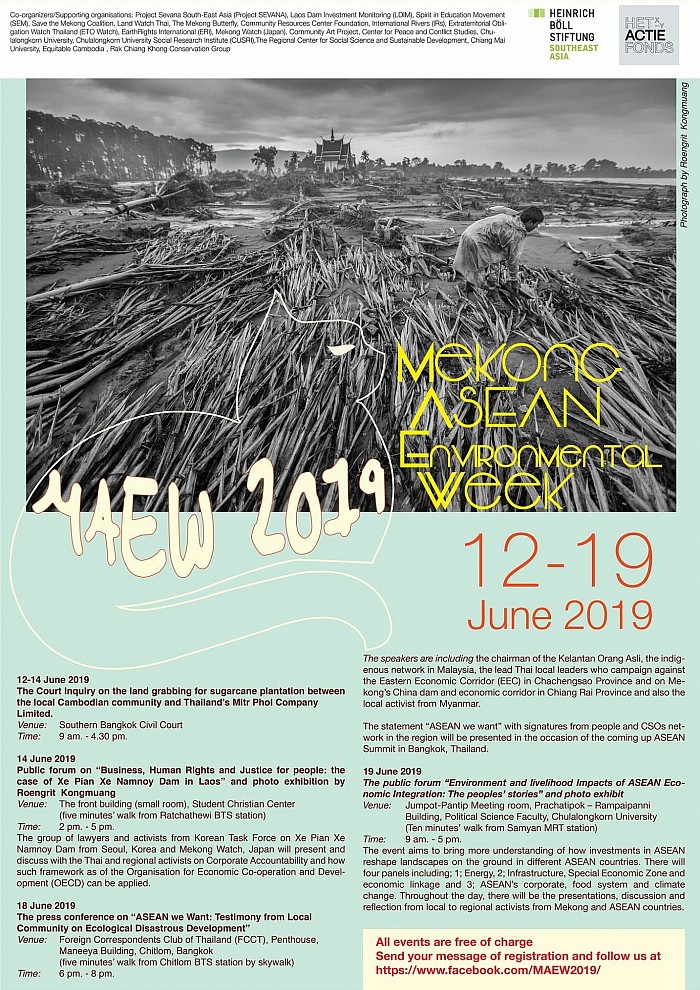
12-19 June 2019, Bangkok, Thailand
It is striking how natural resources-based livelihoods have shifted rapidly due to large-scale developments by government policy in ASEAN countries and opening up for foreign investors outside the region and/or intraregional investors such as the Chinese to invest in natural resource extractions. Although countries in the Lower Mekong region, such as Cambodia, Lao PDR, and Vietnam, have different political regimes, histories, and different groups of elites which shape the government’s development agendas, the governments heavily focus on infrastructure development and the way in which these countries undergo development have shared similar patterns and models. For example, the model of hydropower development or
damming the Mekong River as a national development priority, coupled with industrialization for exporting, oil and gas exploration for energy security, the Special Economic Zone development, and increasing connectivity through trade and infrastructures have resulted in similar impacts on the ground – natural resource depletion and grabbing as well as adverse environmental and social impacts.
Large-scale infrastructure development projects can have significant environmental, social, and cultural impacts that alter community livelihoods to an irreversible level. Moreover, the development projects may cause transboundary impacts to the neighboring countries, especially problems associated with resource extractions and unjust development that ignores the voices of the communities, such as wastes and pollution released from factories, flash flooding and releases from dams, and transboundary air pollution caused by large scale forest burning for contract farming and emissions from factories or industries. Unjust development has notably negative consequences, resulting in large-scale migration and resettlement or migration across borders.
Considering the threats and the intense natural resource depletion that the ASEAN region faces, cooperation in good spirit among ASEAN countries has been fundamental- since ASEAN was established and the ASEAN Charter has been endorsed. The three pillars of the ASEAN Charter have been acknowledged as the main driving force of ASEAN integration and revolution. The ASEAN community is a community of opportunities under three community pillars: Political Security, Economic, and Socio-Cultural. However, the focus on the AEC blueprint and ignoring social and cultural pillars have negatively impacted community subsistence livelihoods.
Mekong/ASEAN Environment Week 2019 (MEAW) or MEAW 2019 will occur in Bangkok, Thailand, from 12-19 June 2019. The focus of MEAW is impacted by large-scale infrastructure developments and impacts in the ASEAN region – specifically, unjust development pushed forward by intra-regional investors such as Chinese and Thai investors. Since Thailand has assumed the chairmanship of ASEAN this year, Thailand’s role in the region is crucial to ‘Advancing partnership for sustainability’ and is the driving principle of Thailand’s chairmanship. Addressing changes and challenges, such as the issue of natural resource depletion across the ASEAN region, is one of the top priorities.
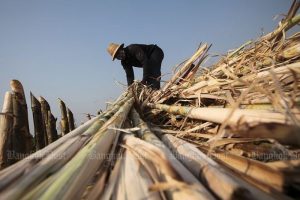
Wednesday 12-14 June 2019 – The court Inquiry on the sugarcane plantation and land grabbing in Oddor Meanchey Province, Cambodia, between the local community representatives and Mitr Phol Company Limited.
Venue: Southern Bangkok Civil Court
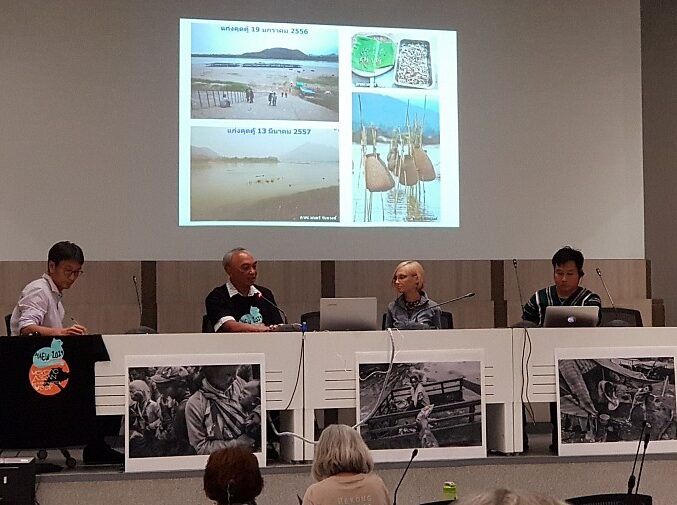
Public forum/discussion on “Business, Human Rights and peoples’ justice: the case of Xe Pian Xe Namnoy in Laos”
Date: Friday 14 June 2019
Venue: Student Christian Center, Ratchathewi, Bangkok at 14.00-17.00
Greetings and introduction of Mekong-ASEAN Environmental week (MAEW2019) by Premrudee Daoroung, Project SEVANA South-East Asia/Laos Dam Investment Monitor (LDIM)
The short video “After the dam collapsed, Xepian Xenamnoy Dam, Laos” by Mekong Watch
Date: Friday 14 June 2019
Watch the video here: https://youtu.be/jqtb5gHdjl0
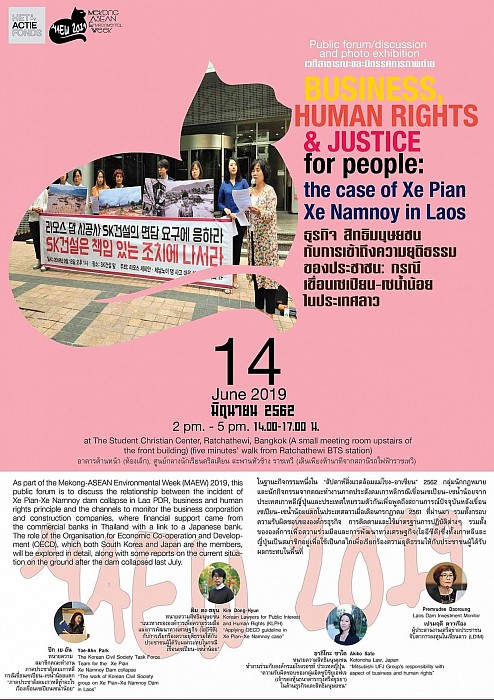
Presentations;
- Xe Pian-Xe Namnoy case and the submission to the National Human Rights Commission of Thailand by Sor.Rattanamanee Polkla, a representative from the Extraterritorial Obligation Watch Thailand (ETO Watch)
- Mitsubishi UFJ Group’s responsibility with the aspect of business and human rights by Akiko Sato, Lawyer, Mekong Watch Associate
- The work of the Korean Taskforce by Yae-Ahn Park, lawyer, Korean Task Force on Xe Pian Xe Namnoy Dam
- Applying OECD guideline in Xe Pian-Xe Namnoy case by Donghyun Kim, lawyer, Korean Task Force on Xe Pian Xe Namnoy Dam
- Question/Answer and discussion
Moderator: Shalmali Guttal, Focus on the Global South (FOCUS)
Watch the Video of the forum here https://fb.watch/2Wxk9-Rusw/
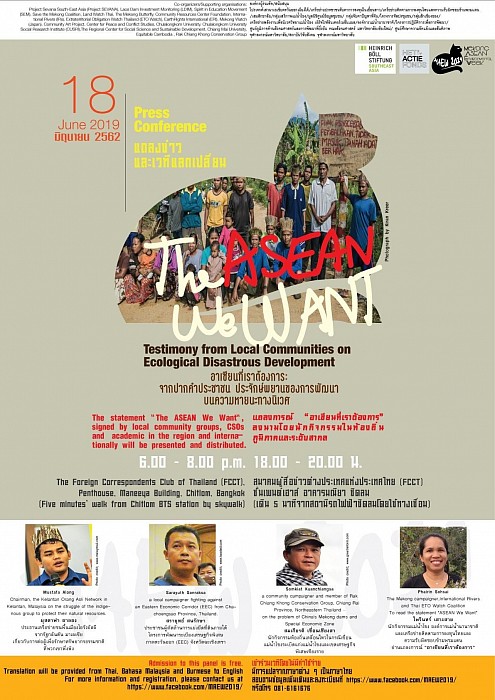
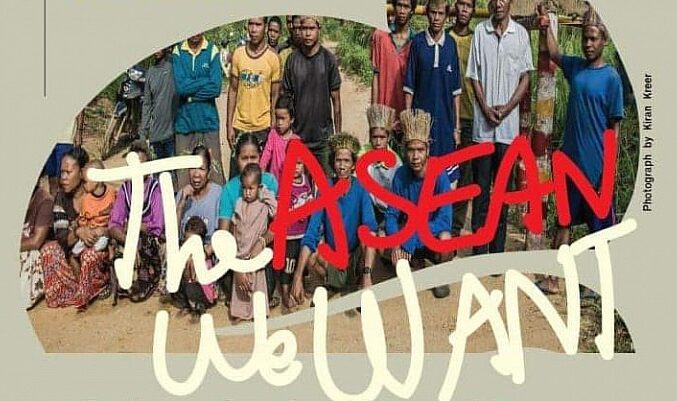
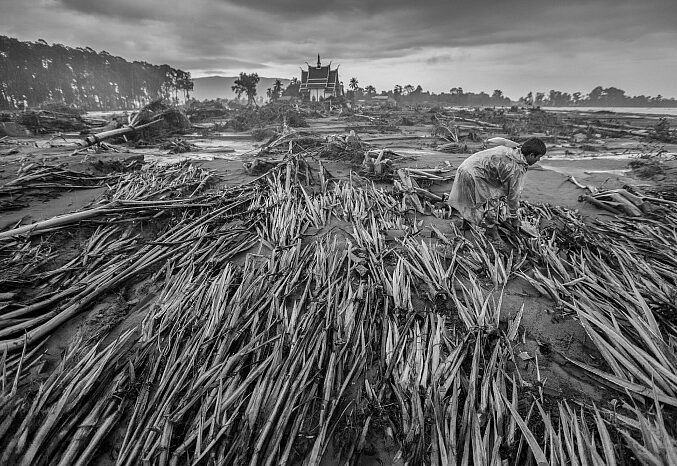
The press event and photos exhibit on “The ASEAN We Want Testimony from local Communities on Ecological Disastrous”
Date: Tuesday 18 June 2019
TIme 18.00-20.00
Venue: Foreign Correspondents Club of Thailand (FCCT), Penthouse, Maneeya Building, Chitlom, Bangkok (five minutes’ walk from Chitlom BTS station)
Speakers
- The struggle of the Orang Asli people in Malaysia on forest and land grab by Mustafa Along, the chairman of the Kelantan Orang Asli Network
- Special Economic Zone (SEZ) and Eastern Economic Corridor in Thailand by Sarayuth Sonraksa the Eastern Economic Corridor (EEC) campaigner, Chachoengsao Province
- Mekong dams and the impacts on the region by Somkiat Kuanchiangsa, Rak Chiang Khong Conservation Group, Chiang Rai Province
- Question and discussion
Moderator: Premrudee Daoroung, Project SEVANA South-East Asia
Watch the video of the event here https://fb.watch/2WxgX-tGA8/
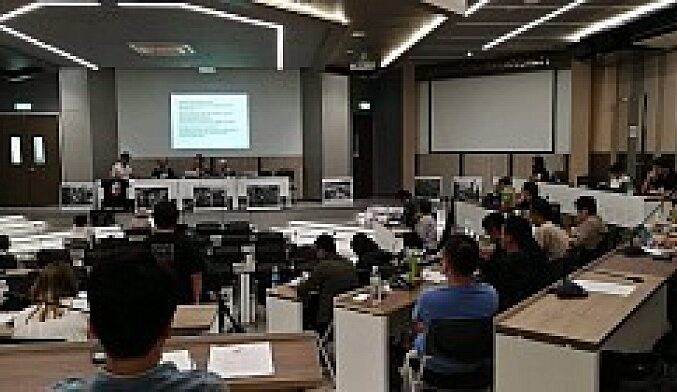
The public forum “Environment and livelihood Impacts of ASEAN Economic Integration: The peoples’ stories” and photo exhibition
Date: Wednesday 19 June 2019 – The public forum “Environment and livelihood Impacts of ASEAN Economic Integration: The peoples’ stories” and photo exhibit
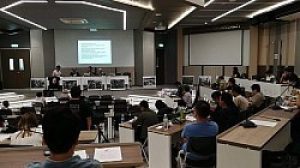
Venue: Jumpot-Pantip Meeting room, Prachatipok – Rampaipanni Building, Political Science Faculty, Chulalongkorn University (Ten minutes’ walk from Samyan MRT station)
9.00-9.30 Greetings by Prof. Surichai Wankeo, Director, Center for Peace and Conflict Studies and Premrudee Daoroung, Coordinator, Project SEVANA South-East Asia
Music by the AMP3, the musician group from Southeast Asia countries
9.30-11.00 On Energy
- Mekong dams and cross-border impacts by Montree Chantawong, The Mekong Butterfly
- The situation on the ground and Japan-related investment on Xe Pian Xe Namnoy dam by Tanya Robert, Mekong Watch, Japan
- The energy situation in Myanmar by Saw Tha Phoe, Karen River Watch
Moderator Gary Lee, International Rivers
Watch the video of this part here https://fb.watch/2-MplVRtzG/
11.00-11.30
Coffee Break (With the short film on Xe Pian-Xe Namnoy by Mekong Watch)
11.30-12.30 On Infrastructure, Special Economic Zone and economic linkage
- Special Economic Zones (SEZ) in the Mekong region by Pornpana Kuaycharoen, Land Watch Thai
- Road link for Dawei Deep Sea Port by Teerachai Sanjaroenkij, Mekong Butterfly, ETOs Thailand
- The situation in Cambodia by Riden Sun, Focus on the Global South
Moderate and reflect Prapart Pintoptang, Chulalongkorn University Social Research Institute (CUSRI)
Watch the video of this panel here https://fb.watch/2-MsoGBkE_/
12.30-13.30 Lunch break
13.30-15.00 On ASEAN’s corporate, food system and climate change
- Impacts of the corporate food system on food diversity by Ubon Yoowah, Sustainable Agriculture Network
- Forest, food security and community work by Hafizudin Nasarudin, Persatuan Aktivis Sahabat Alam – KUASA (Environmental Activists Society), Malaysia
Moderate and reflect Wora Sukraroek, EarthRights International
Watch the video of this panel here https://fb.watch/2-Mt_GgqUo/
15.00-15.30 Coffee break
15.30-16.30 Reflection and discussion (15 minutes each and open forum)
Shalmali Guttal, Focus on the global South (FOCUS)
Witoon Permpongsacharoen, Mekong Energy and Ecology Network (MeeNet)
Debbie Stothard, Atsean Burma
Moderator Premrudee Daoroung, Project SEVANA South-East Asia
Watch a video of this panel here https://fb.watch/2-Mw7cRUPO/
16.30
Thank you speech by Representative from the organizers
Co-organizers/Supporting organizations: Project SEVANA South-East Asia (Project SEVANA), Laos Dam Investment Monitoring (LDIM), Spirit in Education Movement (SEM), Save the Mekong Coalition, Land Watch Thai, The Mekong Butterfly, Community Resources Center Foundation, International Rivers (IRs), Extraterritorial Obligation Watch Thailand (ETO Watch), EarthRights International (ERI), Mekong Watch (Japan), Community Art Project, Center for Peace and Conflict Studies, Chulalongkorn University, Chulalongkorn University Social Research Institute (CUSRI), The Regional Center for Social Science and Sustainable Development, Chiang Mai University, Equitable Cambodia, Rak Chiang Khong Conservation Group
Thank you: Het X-Y Actiefonds and Heinrich-Böll-Stiftung Southeast Asia
News coverage
Thai PBS https://fb.watch/2-hQrNdGBI/
Radio Free Asia https://fb.watch/2-se1SaaGs/
The ASEAN We Want
Testimony from Local Communities on Ecologically Disastrous Development
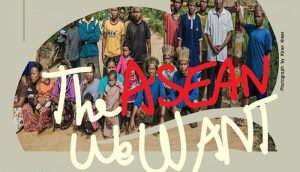
6pm, Tuesday 18 June, 2019
At Foreign Correspondents Club of Thailand, Penthouse, Maneeya Building, Chitlom
The event is part of the Mekong ASEAN Environment Week (MAEW) 2019, organized by a consortium of civil society organizations, local community groups, and academics in Thailand, Mekong, and Southeast Asian countries[1], who are advocating for fair and just development that respects the community’s rights to natural resources and human rights.
The focus of MEAW is on the adverse impacts of large-scale infrastructure developments and impacts in the ASEAN region—specifically by investors from within and outside the region. This year, Thailand has assumed the chairmanship of ASEAN. The first MAEW is being organized in the lead-up to the ASEAN Summit, which will be held in Bangkok from 20 to 23 June.
At the press conference, representatives from Malaysia, Myanmar, and Thailand will share their experiences campaigning against large-scale projects to protect their livelihoods, environment, and natural resources. Speakers include:
Moderator: Premrudee Daoroung, coordinator of Project SEVANA South-East Asia and Laos Dam Investment Monitor (LDIM)
[1] Co-organizers/Supporting organizations: Project SEVANA South-East Asia (Project SEVANA), Laos Dam Investment Monitoring (LDIM), Spirit in Education Movement (SEM), Save the Mekong Coalition, Land Watch Thai, The Mekong Butterfly, Community Resources Center Foundation, International Rivers (IRs), Extraterritorial Obligation Watch Thailand (ETO Watch), EarthRights International (ERI), Mekong Watch (Japan), Community Art Project, Center for Peace and Conflict Studies, Chulalongkorn University, Chulalongkorn University Social Research Institute (CUSRI), The Regional Center for Social Science and Sustainable Development, Chiang Mai University, Equitable Cambodia, Rak Chiang Khong Conservation Group
Video of the event https://fb.watch/2WxgX-tGA8/
The ASEAN We Want:
Mustafa Along, Chairman of the Kelantan Orang Asli Network in Kelantan, Malaysia. Mustafa will discuss Orang Asli indigenous network’s campaigns to protect people’s forests and lands from loggers and miners.
Sarayuth Sonraksa, a local campaigner fighting against an Eastern Economic Corridor (EEC) in Chachoengsao Province, Thailand, which is being supported by large businesses and resulting the land grabbing in the area.
Somkiat Kuanchiangsa, a community campaigner and member of Rak Chiang Khong Conservation Group, Chiang Rai Province, Northeastern Thailand. Somkiat will discuss the impacts of China’s Mekong dams and Special Economic Zone.
Phairin Sohsai, a Mekong activist from International Rivers and Thai ETO Watch Coalition. Phairin will read the statement “The ASEAN We Want,” signed by local community groups, CSOs, and academics in the region and internationally.
Statement
The ASEAN We Want
Jun 20, 2019
In 2009, Civil Society Organisations (CSOs) based in Southeast Asia and working closely with local communities on environmental, social, and human rights issues, proposed the ASEAN-Civil Society Dialogue on Environment [1] as a framework to dialogue with ASEAN. The proposed framework asked that “ASEAN should launch a fourth Strategic Pillar on Environment and prepare a blueprint that commits the member states to place international best practices on environmental sustainability at the center of decision-making.” The framework outlined three core themes of concern for dialogue:
- Large-scale development projects that lead to environmental and livelihood destruction, especially hydropower dams on the Mekong and Salween Rivers and extractive industry sectors (oil, gas, and mining).
- Climate Change, which increasingly highlights the vulnerability of the region.
- Biodiversity, which is threatened by large-scale development projects to achieve rapid economic growth. The loss of the region’s rich biodiversity has exacerbated inequality and food insecurity in the region and created “the lack of access and control over land, water, productive resources, genetic resources, as well as social protection.”
Despite growing evidence that environmental destruction and degradation are the main causes of livelihood insecurity and violation of peoples’ rights in the ASEAN region, there have been no improvements by governments, businesses, and corporations in addressing environmental problems over the past decade. Instead, people are witnessing and experiencing rapid losses of land, water sources, forests, minerals, biodiversity, and good air quality. The impacts of climate change have already resulted in tremendous uncertainty about peoples’ futures, especially those who live in ecologically and economically vulnerable conditions.
ASEAN’s prioritization of economic integration and linkages to build the ASEAN Economic Community (AEC) has encouraged member countries to welcome foreign investors with little regard to the negative impacts on people’s territories, livelihoods, and economic conditions. Backed by politically and financially powerful countries and international financial institutions, private investors have become increasingly more aggressive in their demands to ASEAN governments, and wield far greater influence over policy and law-making than ten years ago. By agreeing to investor protection mechanisms such as Investor-State Dispute Settlement (ISDS), ASEAN governments have weakened their abilities to protect local populations, environments, and public interest from encroachments by investors.
On the occasion of the ASEAN Summit in Bangkok, Thailand from 20-23 June 2019, we, peoples, communities, and CSOs from Southeast Asia, and members of concerned international communities present our hopes and demands for a just, prosperous, and genuinely sustainable ASEAN. Given our experiences and the trends we have witnessed in the region and globally, we want an ASEAN where:
- The value of nature as the basis of life and foundation for sustainable development is recognized and respected by all, and not reduced to monetary value and pricing.
- Public interest is understood as upholding the needs of the majority of the population, not the interests of elite and wealthy members of society.
- Economic development does not destroy or degrade the environment and undermine the livelihoods and rights of local peoples and communities.
- Resources are distributed and governed to ensure equitable access, especially with regard to critical resources such as food, land, water, and energy, and for economically and socially vulnerable peoples/communities.
- The roles and importance of local communities in protecting and regenerating the vitality of eco-systems and natural wealth are recognized, respected, and upheld by governments;
further, the ancestral territories of indigenous peoples are appropriately recognized and respected, and their roles in environmental conservation are promoted and supported. - Diversity means that different ethnic nationalities and genders can practice their cultures with full social and legal support, and are protected against prejudice and discrimination.
- Peoples’ visions and practices of food sovereignty, agroecology and environmental stewardship are realized and supported in all their dimensions.
- Governments put the needs and aspirations of local communities, food producers, workers and indigenous peoples over the interests of corporations and businesses. Especially important here are the needs of women and youth in all sectors and strata.
- The investments made by local people and communities in producing food and protecting their environments are protected by law, and respected over those of private, corporate investors.
- Human rights—individual and collective—are upheld in each country as well as regionally, and there are measures to correct past and continuing inequities, inequalities, and injustices. Especially important here are the rights of women, indigenous peoples and workers.
- There are no evictions, displacement, dispossession and resettlement of local populations, and peoples’ access to the commons are not restricted or lost.
- The rule of law protects people and the environment, not businesses and corporations, and ensures justice for all, especially the most vulnerable and historically marginalized and exploited.
- Investor protection provisions (including ISDS) are removed from trade and investment laws and agreements, and investors are held legally accountable for negative impacts and human rights abuses resulting from their projects.
- Low carbon and non-extractivist development model is adopted by all countries.
Overall, we ask for a common and collective understanding that “A people-centered ASEAN” cannot be achieved unless the roles, rights, and livelihoods of people are sincerely respected and upheld by ASEAN governments and other relevant actors, especially businesses and corporations. We look forward to a real, meaningful dialogue with ASEAN governments, and to working with you to build a better region.
Signed By
- 3S Rivers Protection Network (3SPN), Cambodia
- Aksi for gender, social and ecological justice, Indonesia
- Alliance for Conflict Transformation (ACT), Cambodia
- Alternative Forum for Research in Mindanao (AFRIM), Philippines
- ALTSEAN-BURMA
- Assembly of the Poor Pak Mun Dam, Thailand
- Alyansa Tigil Mina (ATM), Philippines
- Aniban ng Manggagawa sa Agrikultura (Farm Workers Union), Philippines
- Asian NGO Coalition (ANGOC)
- Ayeyawady Youth Network, Myanmar
- Bago Woman Development Group, Myanmar
- Bayay Sibuyanon, Inc., Philippines
- Baywatch Foundation, Philippines
- Both ENDS, Netherlands
- CamASEAN Youth’s Future (CamASEAN), Cambodia
- Cambodian Center for Human Rights (CCHR), Cambodia
- Cambodian Human Rights Action Coalition (CHRAC), Cambodia
- Cambodia Labour Confederation (CLC), Cambodia
- Cambodian Volunteers for Society, Cambodia
- Centre for Social Research and Development (CSRD), Vietnam
- Coalition of Cambodian Farmer Community (CCFC), Cambodia
- Citizen Action for Transparency (CAFT), Myanmar
- Committee for Free and Fair Elections in Cambodia (COMFREL)
- Comité pour le respect des Droits Humains “Daniel Gillard,” Belgium
- Community Peace-building Network (CPN), Cambodia
- Community Resource Centre Foundation (CRC), Thailand
- Community Response Group (COMREG), Myanmar
- Cooperation Committee for Cambodia (CCC), Cambodia
- Culture and Environment Preservation Association (CEPA), Cambodia
- Culture Identity and Resources Use Management (CIRUM), Vietnam
- Dawei Development Association (DWA), Myanmar
- Dawei Probono Lawyer Network, Myanmar
- Dawei Watch Foundation (DWF), Myanmar
- EarthRights International
- Ecological Justice Interfaith Movement (ECOJIM), Philippines
- Environics Trust, India
- ETO Watch Coalition, Thailand
- Europe Solidaire Sans Frontière (ESSF), France
- Focus on the Global South
- Forum Against Disastrous project in Konkan, India
- Foundation for Environmental and Natural Resources (FENR), Thailand
- Freedom from Debt Coalition (FDC), Philippines
- Friends of the Earth, Japan
- GRAIN
- Green Innovation and Development Centre (GreenID), Vietnam
- Greenpeace Thailand
- Human Rights Lawyers Association
- Indian Social Action Forum, India.
- International Accountability Project
- International Rivers
- Kachin Development Networking Group (KDNG), Myanmar
- Kanlat Metta Organization, Shan State, Myanmar
- Karen Environmental and Social Action Network (KESAN), Myanmar
- Karen Rivers Watch, Myanmar
- KIARA, Indonesia
- Kruha, Indonesia
- Khmer Kampuchea Krom for Human Rights and Development Association (KKKHRDA), Cambodia
- LAIN Technical Support Group, Myanmar
- Land Core Group, Myanmar
- Land In Our Hands, Myanmar
- Laos Dam Investment Monitor (LDIM), Thailand
- Law and Policy of Sustainable Development Research Centre (LPSD), Viet Nam
- Living River Association, Thailand
- Malaysian Youth League, Malaysia
- Mandalay Community Centre, Myanmar
- Mekong Butterfly, Thailand
- Mekong Community Institute Association, Thailand
- Mekong Delta Youth (MDY), Vietnam
- Mekong Legal Network
- Mekong Wetland University Network, Vietnam
- Mekong Energy and Ecology Network (MEENet)
- Mekong Watch, Japan
- Migrant Forum Asia
- MiningWatch Canada
- Minority Rights Organization (MIRO-Cambodia)
- Mong Pan Youth Association, Myanmar
- Myanmar Cultural Research Society (MCRS), Myanmar
- Myanmar People Alliance (MPA), Shan State, Myanmar
- NGO Forum on Cambodia, Cambodia
- Nyan Lynn Thit Analytica, Myanmar
- Pace On Peaceful Pluralism, Myanmar
- Pakistan Fisherfok Forum, Pakistan
- Paungku, Myanamar
- People and Nature Reconciliation, Vietnam
- People’s Empowerment Foundation, Thailand
- Perlumpulan AEER, Indonesia
- Persatuan Aktivis Sahabat Alam (KUASA), Malaysia
- Philippine Movement for Climate Justice (PMCJ), Philippines
- Program on Alternative Development, University of the Philippines Centre for Integrative and Development Studies (UP CIDS AltDev), Philippines
- Project Sevana South-East Asia
- Qadir Law Associates, Pakistan
- Radio Emergency Communications Network Philippines, Inc. (RECON Philippines)
- Regional Center for Social Science and Sustainable Development (RCSD), Thailand
- River Basin Friends, India.
- Salween Basin Community Network, Mae Hong Son, Thailand
- Shwechinthae Social Support Group, Myanmar
- Sibuyanons Against Mining (SAM), Philippines
- Southern Youth Organization, Tanintharyi, Myanmar
- STAR Kampuchea, Cambodia
- Suara Rakyat Malaysia (SUARAM), Malaysia
- Summer Shelter Library, Shan State, Myanmar
- Synergy-social harmony organization, Myanmar
- Taunggyi Education Network, Myanmar
- The Corner House, UK
- UNLAD-BLFFA, Philippines
- Urgent Initiative, Philippines
- World Rainforest Movement
- Worker’s Information Centre (WIC), Cambodia
- Women’s Network for Unity, Cambodia
- Youth Resource Development Program (YRDP), Cambodia
NOTES:
[1] “ASEAN-Civil Society Dialogue on Environment”, 2nd ASEAN Peoples’ Forum/5th ASEAN Civil Society Conference, 18-20 October 2009, Cha-am, Phetchaburi Province, Thailand. Working group: Chulalongkorn University Social Research Institute (CUSRI); Thai NGO Coordinating Committee on Development (NGO-COD); People’s Empowerment Foundation, Sustainable Agriculture Foundation; Thai Volunteer Service (TVS); Altsean-Burma; Asian Forum for Human Rights and Development (Forum-Asia); Committee for Asian Women (CAW); Focus on the Global South (FOCUS); Southeast Asia Committee for Advocacy (SEACA); Towards Ecological Recovery and Regional Alliance (TERRA); Union Network International, Asia-Pacific Regional Office (UNI-APRO) Supporting organizations: Towards Ecological Recovery and Regional Alliances (TERRA), Alternative Agriculture Network Thailand; Thai Working Group for Climate Justice; Ecological Awareness Building (EAB); Biothai; PalangThai; Living River Siam (SEARIN), Action Group on Erosion Technology and Concentration (ETC Group), Bank Information Centre (BIC), Focus on the Global South (FOCUS); International Rivers (IRs); Alyansa Tigil Mina
News coverage
Thai PBS https://fb.watch/2-cyBtLd3O/
Related news on Mustafa’s work and Orang Asli struggle Land rights: Court rules in favour of Temiar Orang Asli | The Star