Sharing from Yuam–Salween–Mekong Communities Impacted by State Development Projects
On September 28, 2025, the Mekong–ASEAN Environmental Week (MAEW) 2025 hosted a range of activities, seminars, exchanges, and documentary screenings under the theme “Fake Green: From Green Lies to People’s Power,” a global struggle shared across Southeast Asia.
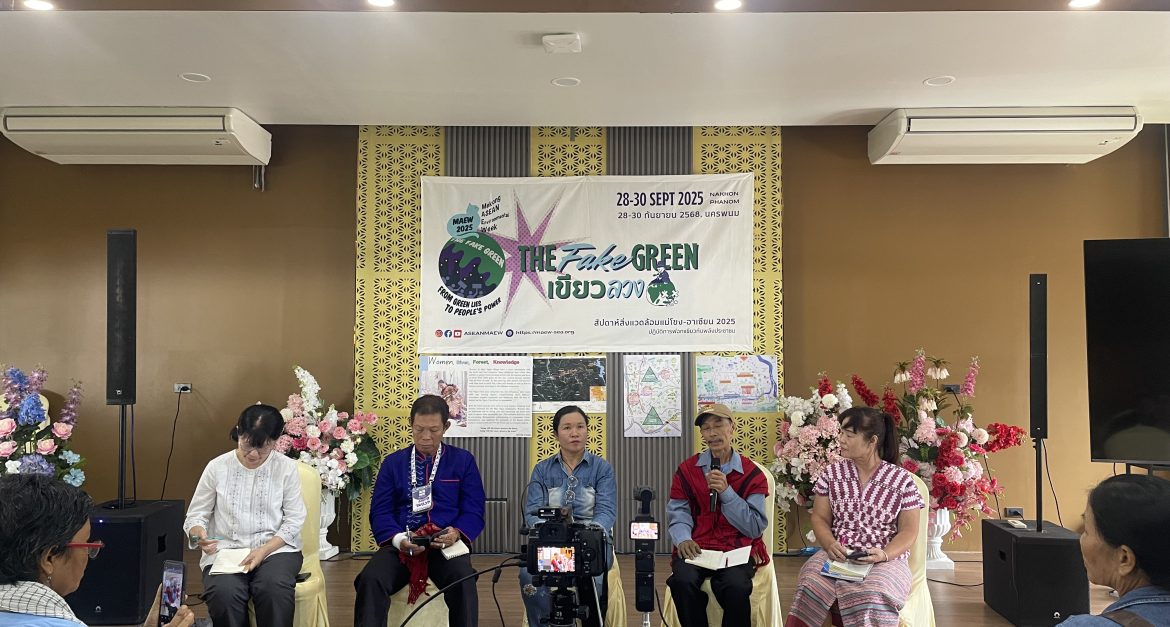
In the session “Community Power: Experiences from the Yuam River,” delegates from community networks affected by state renewable energy projects participated. These projects stemmed from national action plans implemented by successive governments.
Representatives from the Mun River mouth (Pak Mun Dam) network and communities affected by the Yuam–Salween water diversion project joined the session to exchange experiences, discuss the impacts they faced, and voice their collective demands.
Puangpayom Khanyai, Delegate from Pak Mun Dam
Puangpayom Khanyai said that villagers have been affected by the Pak Mun Dam for over thirty years. Similar to Mr. Kanin Chueduangpuy’s speech earlier in the MAEW 2025 opening sessions, she noted that the state does not listen to the voices of ordinary people. In 1989, survey teams visited the site to assess it for the Pak Mun Dam. Although local communities opposed the project, the government bypassed them and insisted on building the dam, using promises of hydropower generation and compensation for impacts. Nevertheless, villagers have opposed the dam ever since.
At first, the extent of the damage and impact was unclear. Over time, however, they became increasingly evident. When she was young, Puangpayom recalled that her parents brought home many species of fish, such as Kerng, Kaeng, and other local varieties. These species no longer exist. Instead of fishing for themselves, villagers have been forced to buy Thai mackerel from markets. The fish ladder at the dam was promised to be functional, but in reality, no fish have been able to swim upstream. It was merely a decoy used by the state.
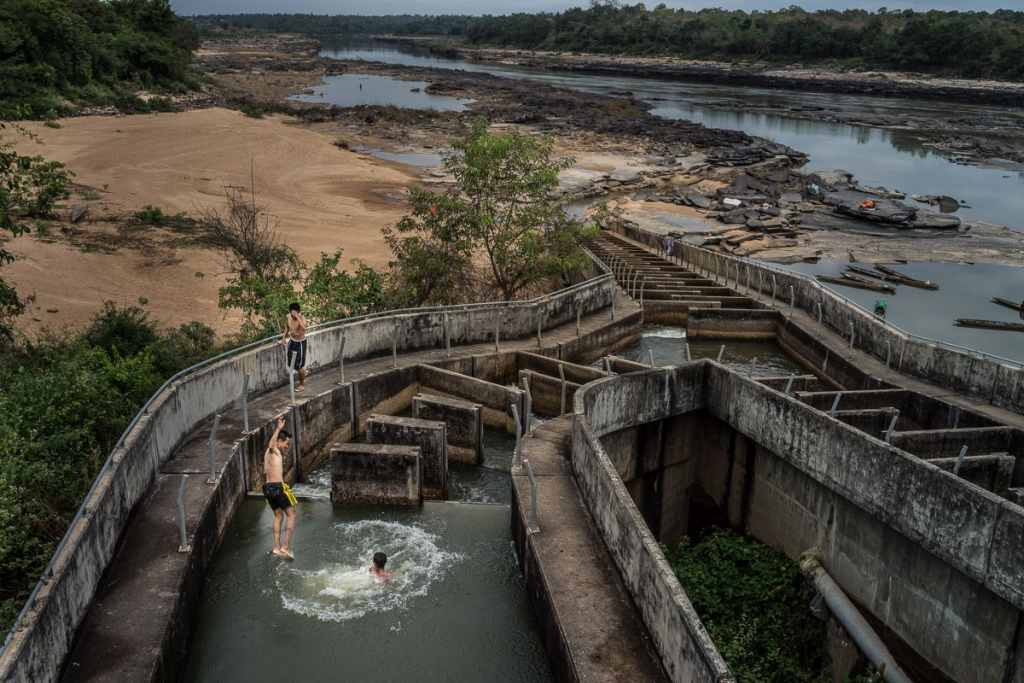
(Fish ladder. Credit: Suthep Kritsanavarin)
Puangpayom added that villagers have repeatedly submitted letters requesting government assistance, including the allocation of 15 rai (2.4 hectares) of farmland for agricultural use. Since they do not own land, this request is essential to compensate for the loss of fishing livelihoods. This demand has persisted for more than thirty years. During Chavalit Yongchaiyudh’s administration, on April 29, 1997, villagers submitted their demands to Plodprasop Suraswadi, then the deputy minister of the Ministry of Agriculture and Cooperatives … and his working group in hopes of receiving assistance.
At that time, communities affected by the Sirindhorn Dam received compensation. However, in the case of Pak Mun, villagers were told to wait. When central government funds ran out, they were required to submit new letters, creating a vicious cycle. During Thaksin Shinawatra’s administration, academics at Ubon Ratchathani University conducted a study on the impacts of the Pak Mun Dam, which confirmed that the dam had harmed local communities.
“Even though villagers have information and research that provide evidence of their suffering, this problem has still not been resolved for over thirty years,” Puangpayom said.
On May 16, 2025, the Assembly of the Poor, led by Sompong Wiangchan, traveled to Ubon Ratchathani City Hall to submit a demand letter calling for land allocation for communities affected by the Pak Mun Dam for more than thirty years. A total of 1,600 families demanded 15 rai of farmland per household across three districts: Khong Chiam, Sirindhorn, and Phibun Mangsahan.
They also demanded that the Mun River Management Committee order the Electricity Generating Authority of Thailand (EGAT) to open all eight gates of the Pak Mun Dam. This would allow fish to swim upstream and spawn during the rainy season, while also reducing flood risks in Ubon Ratchathani city and Warin Chamrap district.
” Currently, there is a new dam project called the Phu Ngoy Dam, which will affect communities in Pak Mun and in Lao PDR. If this dam is built, Pak Mun’s fate will be repeated through state development projects,” Puangpayom said.
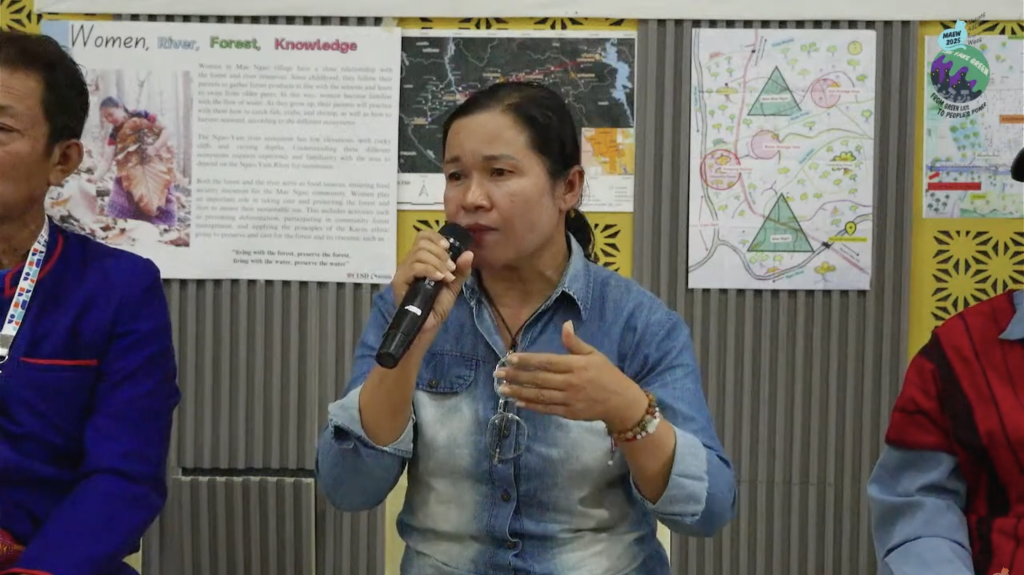
She further explained that in the past, the river supported a wide variety of fish species, which gradually disappeared from the ecosystem. In Ban Payam, communities now face plans to blast river rapids to construct riverbank walls. Villagers are forced to relocate slightly farther away, even as they continue fishing. Even if compensation is provided, the loss of natural rapids is not worth it. Even if the Pak Mun Dam were demolished, the ecosystem would not fully recover due to the deep blasting of the river rapids. Today, nearly all natural riverbanks and rapids in the area have disappeared.
Ultimately, it is clear that state dam construction has led to the loss of fish species, ecosystems, and livelihoods. Fishing once sustained entire communities. Without fish stocks, younger generations are forced to migrate to cities in search of work.
“Everyone has dreams. I also dream of having at least 15 rai of farmland, transitioning from fishing to agriculture, and growing rotational crops. My family members who moved to Bangkok could return home and rebuild their lives here. The cost of living in Bangkok is very high, making it difficult for them to send money home. This, too, is an impact of the dam,” Puangpayom said.
On September 26, 2025, the Assembly of the Poor submitted a letter to Thamanat Prompow, Deputy Prime Minister and Minister of Agriculture and Cooperatives. The group gathered at the ministry to submit letters addressing multiple issues, including land rights, impacts of the Pak Mun and Rasi Salai dams, forest-area disputes, and labor issues. Prompow later wrote a note stating, “Please trust that I will expedite these cases for poor people.”
Singkharn Ruenhom and Yupa Jopae, Delegates from the Yuam–Salween Water Diversion Project
Singkharn Ruenhom is from Mae Ngao village in Sob Moei District, Mae Hong Son Province, where the water diversion tunnel begins. Yupa Jopae is from Mae Ngud village in Hod District, Chiang Mai Province, located at the end of the tunnel. Both villages are affected by the Yuam–Salween water diversion project, a large-scale state development initiative. Although no dam will be built directly on the Salween River, water will be diverted from Salween tributaries to the Bhumibol Dam.
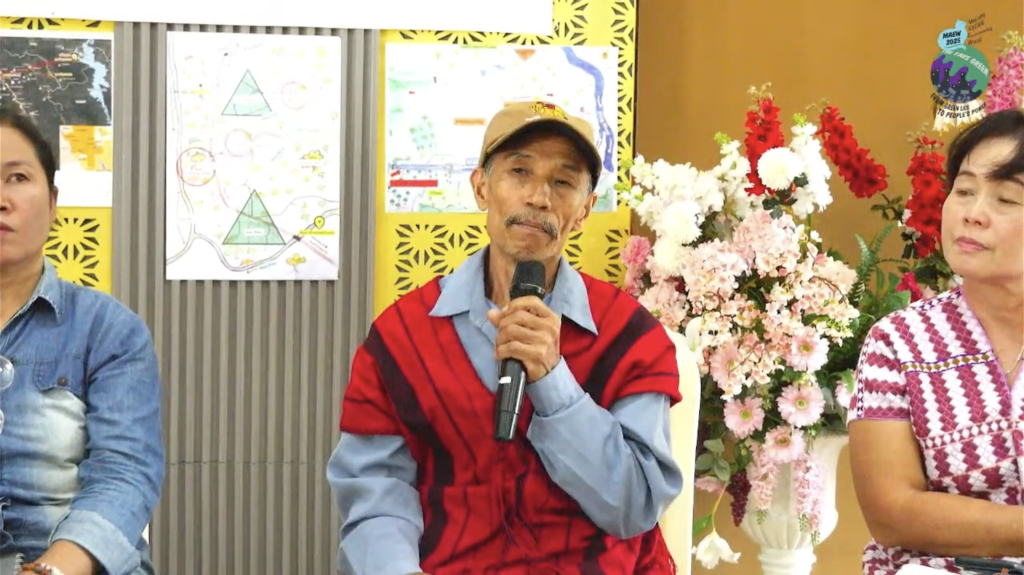
“I want people to see that the Mekong and Salween rivers are sisters. The Mekong is the older sister who has already been bullied, and soon the Salween may face the same fate. Fortunately, we still have each other. There is a large project planned to divert water from the Salween River to Bhumibol Dam in Tak Province, with an estimated budget of at least 100 billion baht,” Singkharn said.
He explained that the Mekong River offers a life lesson for the Salween River. Both rivers originate on the Tibetan Plateau. The Mekong flows through China, Laos, Thailand, Vietnam, and Cambodia, while the Salween also begins in Tibet. Between the two rivers, the left bank of the Salween remains more intact. However, how long this will last does not depend solely on Thailand. Currently, about 50 percent of the Mekong River has been degraded, while 80–90 percent of the Salween River remains relatively intact.
The Salween River basin has become a target for wealthy interests seeking to extract benefits, while local communities are stigmatized as grassroots and marginalized. Communities in the Salween basin face even harsher treatment because they are ethnic groups, particularly Karen Indigenous communities, whose lives were never divided by the Thai–Myanmar border.
“When the border was drawn, I was placed on the Thai side, while many others were placed on the Myanmar side. Their voices are not heard. Authorities see these people as small voices that need development. The problem is that state-led development does not consider local people. It only promotes development that crushes innocent lives,” Singkharn said.
Mae Ngud village in Hot District, Chiang Mai Province, was settled more than one hundred years ago, even before the construction of Bhumibol Dam. At that time, villagers had their own farming areas. When the dam was built in 1965, backwater flooding submerged the area, forcing every household to relocate.
At the other end of the planned tunnel, Yupa recalled the ecosystem and ways of life of the Mae Ngud community. Today, villagers continue to suffer from backwater impacts when the Bhumibol Dam restricts water flow during the rainy season. Yupa explained that each Karen village has distinct beliefs. Typically, the front of a village serves as a cemetery for adults, while the side is reserved for children. When backwater levels rose, all farmland disappeared. Ancestors moved uphill to cultivate land and sustain their families. About twenty years later, cash crops, especially longan, were introduced. Today, longan farming accounts for nearly 100 percent of household income in Mae Ngud. Although longan prices were very low this year, villagers had no choice but to continue farming to support their children.
“In the beginning, I did not know whether the water diversion was good or bad. One group secretly brought public hearing documents into the village through public health volunteers. These documents were given to elders who did not understand Thai, and they signed without knowing what they were signing. Later, other groups came in. Then, delegates from the Regional Center for Social Science and Sustainable Development (RCSD), Chiang Mai University met with the village leader and gathered villagers to collect information. At that point, villagers began to understand the project and started to resist it. They realized it was not worth it. When officials conducted surveys, they did not even explain how deep the water trenches would be,” Yupa said.
Singkharn emphasized that budget size is not the main issue. What matters are the land, rivers, and clean water resources, such as shrimp, shellfish, crabs, and fish, all of which would be destroyed. Their abundance would disappear, as has already happened in the Mekong River. Fertile soil would be excavated to build an eight-meter-wide tunnel cutting through mountains from the Moei River to the Salween River. This excavation and dredging would severely affect ten villages. Yet the project’s research studies and Environmental Impact Assessment (EIA) make no mention of these impacts. Villagers were initially unaware of the project, and by the time they learned about it, the EIA had already been approved.
In response, communities have worked with RCSD to conduct alternative EIA processes under the Ngao–Yuam–Salween Ethnic Study Group, comparing their findings with the state EIA prepared by the Water Department.
“We tried modeling impacts in two villages using the Water Department’s approved EIA—an EIA that villagers knew nothing about. The income figures and data on shellfish, crabs, and fish in the report were nonsense. In some cases, Mekong fish species were used to describe the Salween River. Local communities immediately recognized that it was wrong. I once raised this issue in Bangkok. It was like they brought a dog and called it a pig,” Singkharn said.
The map of the Yuam–Salween water diversion project illustrates how water would be diverted from Salween tributaries to Bhumibol Dam.
Singkharn added that the Salween River’s ecosystems naturally protect riverbanks and provide habitats for fish. If the project proceeds, these systems would be destroyed. Ethnic communities would lose their legally recognized homes, and some villagers have already been arrested because their house fences are located near forest reserves or national parks. Villagers are therefore forced to stand up and fight for their homes. The Mekong River, he said, offers a clear lesson. The government has implemented similar projects for more than thirty years and should seriously examine their outcomes.
“Even with the Ping Dam, the largest dam in Thailand, water levels currently do not reach even 50 percent. It is like fixing a problem by stealing from others—solving problems by burying old ones while creating new ones repeatedly. When large-scale research never truly reaches communities, how can it possibly lead to the right decisions?” Singkharn said.
Experiences from the Mekong–Yuam–Salween basin clearly reveal a development gap between authorities and local communities. While local people bear the impacts, they have not genuinely participated in decision-making processes and are instead told that projects are necessary for economic development and national energy security.
Although these lessons have been evident for decades, similar projects continue to emerge across the Mekong and Salween river basins, from the North to the South, where public participation remains largely a ritual rather than a meaningful engagement process.
Compiled by: Orakot Suksawat
References
อ้างอิง
- https://www.facebook.com/share/1Q9LuLvR6A/
- วิถีการดำรงชีพชาวกะเหรี่ยงในพื้นที่โครงการเพิ่มปริมาณน้ำต้นทุนฯ (Karen People’s Way of Life in Water Supply Area)